The price of the tile does nothing to protect the tile. A $14,000 handmade order set over a failed assembly comes off the wall in the same condition as builder-grade ceramic, which is to say in pieces. Martin Brookes, Fox Marble's Director of Installation and a veteran of more than 40 years in the tile industry, gives homeowners that answer more often than any other, and the call almost always arrives too late to change it.
The call
The pattern is consistent enough that Martin can describe it before it happens.
First thing is usually we get a call from a homeowner who's stressed because they know that it's wrong, but they don't know exactly what's wrong.
The opening line is some version of: we've had a tile person in, we have concerns about the quality of the work, can I send you photos? Martin has them text the photos and reviews them live while they are still on the phone. On a recent call the homeowner had spent $14,000 on handmade tile. The question was whether the tile could be saved.
The tile cannot be saved. Once it's stuck to the wall, it's game over. You're buying the tile again.
Take again literally, because it's the word that costs money. The homeowner is not facing a repair bill. They are facing the original tile invoice a second time, plus demolition, plus the installation they believed they had already purchased.
What the tile was never going to do
There is a quiet assumption underneath most premium tile purchases: that spending more on the surface buys some margin of protection.
It buys none, and Martin is unambiguous about what tile is.
Tile is just a durable decorative surface, and it does not act as a waterproof membrane.
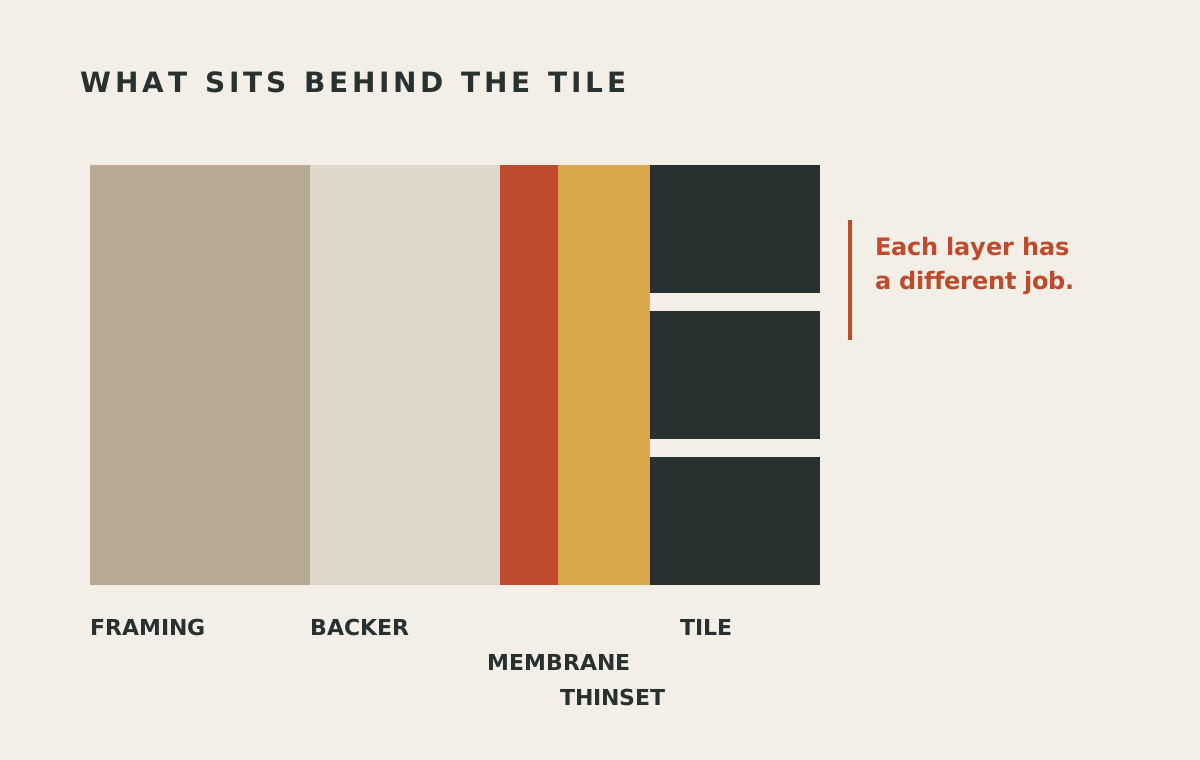
Tile is not a barrier, it is a wear layer. The waterproofing is a separate system installed behind it, and the tile has no opinion about whether that system was done correctly.
The follow-on myth is grout sealer, and he closes it off: "People think putting sealer on grout will help mitigate and stop water intrusion. It will not. It's there really as a protectant for stains, and doesn't add any value as a waterproof membrane." So the money that buys the visible surface buys none of the performance. Which is where Martin locates the mistake, and it is not the tile selection:
People don't tend to care or want to invest too much money on things they can't see, and that is the biggest mistake they can make in any tile project.
Spending follows the visible. Performance sits behind the visible. A larger tile budget does not correct that mismatch, it worsens it, because it raises the cost of the eventual redo without changing the odds of one.
What Martin points at when a client questions the price
He does not hand them a brochure. He walks them to the job site.
He points at the wall prep and the waterproofing. At the three days spent sistering studs and skimming the walls flat and plumb. At the uncoupling membranes on the floor. All of it about to vanish under tile within the week. Then he says this:
The tile is just the wallpaper. You are paying for the engineered system underneath it so your shower doesn't leak into your living room in five years.
Wallpaper is a deliberate choice of word, and it should sting slightly. Nobody expects wallpaper to hold back water. Nobody thinks wallpaper is structural. Applied to a $14,000 handmade order it forces the reframe the whole industry struggles to land: the beautiful thing you selected is the finish, and finishes are not what fail.
Why the qualified bid is the higher one
Fox installs to Tile Council of North America standards and ANSI A108 standards. That matters because it gives "installed correctly" a written definition that does not depend on any installer's judgment, and that a third party can check work against.
Martin sits on the ANSI A108 Committee, the body behind one of those standards, and on the National Tile Contractors Association's Technical Committee, and he has chaired the NTCA's Standards and Methods Committee. He was NTCA president from 2021 to 2023 and received the association's Ring of Honor in 2025. His account of what that access is worth is more useful than the credentials themselves:
I get to know what the failures may be moving forward, but also what best practices are.
Standards get written in response to failures. Sitting where they are written means learning about a failure mode before it arrives on a job site rather than after.
Set that against how much of the field operates. Martin's contrast is with installers "just doing it the way they've done it 20 years without any formal training or any expertise in how to do it right." Notice what he is not attacking. Martin has more than 40 years in the trade, and Fox Marble has been working in the Bay Area since 1986 out of its Richmond facility, and he does not offer either number as the qualification. He offers the standards and the committee seats. Twenty years of an uncorrected method produces a practiced version of the same mistake, and the wall cannot tell the difference between a first-time error and a well-rehearsed one.
Then he says the thing most companies would never put in writing. This depth of knowledge "can leave us at a disadvantage" against less qualified bidders.
That is the bid gap described from the other side. A qualified estimate is higher because it is priced against a standard, and standards cost money to meet. The cheaper bid is not a discount on the same work. It is a different scope, quoted without saying so.
The number one failure
Martin's diagnosis is one sentence long.
They pick the lowest bid. Number one failure, right there.
Then the mechanism: "They don't qualify, pre-qualify the installer. They don't check. They don't ask the leading questions."
The lowest bid is not the failure by itself. Choosing it without checking what was left out is. Nobody comparing three numbers is comparing three identical scopes, but price is the only part of a bid that arrives in the same format across all three, so price is the part that gets compared
The four questions to ask every installer
Martin keeps a list he gives homeowners: the questions to ask the other installers they are considering. There are four.
1. What waterproofing system will you use, and how is it installed? The part you will never see, and the part everything else depends on. An installer who cannot answer this specifically is answering it honestly.
2. Do your staff receive continuing education on the materials they use daily? Not whether the company has been around. Whether the people setting tile have been trained on that product. Martin's warning here is the one people most underestimate:
Even the products out there that work extremely well, without the proper training, they will fail also.
A correct material installed by an untrained crew is still a failure. The product is not the safeguard.
3. Credibility, credentials, and years in business. Tenure is not a credential on its own, but it is checkable, and it belongs in the comparison alongside the rest. The credentials worth more are the ones a third party issues rather than the company: a Certified Tile Installer designation from the Ceramic Tile Education Foundation, or NTCA Five-Star Contractor accreditation. Both can be verified without taking anyone's word for it, which is the whole point of a credential. Fox holds the NTCA Five-Star accreditation; ask any installer you're comparing whether they do too.
4. Do you carry the correct insurance for this specific project?
Insurance is key. If things go wrong, insurance is the first stop. If you don't have the right insurance, it's going to hurt.
This fourth one carries a trap most homeowners do not know exists.
The insurance question almost nobody asks correctly
Martin says installers cheap out on proper insurance and sometimes have not read their own policy. The specific gap he wants homeowners to know about:
Many clients and GCs don't realize that standard General Liability policies for many tile installers strictly exclude multi-family homes or condo buildings.
Ask the installer and its insurance representative to confirm that coverage applies to your project type, including any relevant exclusions. A general statement that a company is insured does not establish what its policy covers for your building.
The point is not that an installer is uninsured. It is that "we're insured" and "we're insured for this building type" are different sentences, and only one of them helps you when something goes wrong.
If your project is a condo, a townhome, or anything multi-family, that question stops being a formality.
Martin's closing instruction on the whole list: "Look at each installer that you've picked side by side, and do an evaluation that you get in real true value."
Where the trade actually failed
The most unusual thing Martin says is that none of this is the homeowner's fault. "Our failure to be able to communicate that in a way that the homeowner, a GC, architect truly understands, that's your biggest risk and liability right now."
He puts the failure on his own industry. Homeowners are not underinvesting in waterproofing because they don't care about their houses. They're underinvesting because nobody has explained, in terms they can act on, that the tile they are paying for is not doing the work they assume it's doing.
A homeowner cannot evaluate a bid using information they were never given.
The real stakes
A premium tile order is not the purchase of a finished surface. It is the purchase of materials, and it only becomes a finished surface if someone builds an assembly capable of holding it. Which is why the tile budget and the installation budget are not competing line items on the same project. One is the cost of the thing. The other is the cost of keeping it.
Choose the lowest installation bid on premium tile and you have not saved money on the installation. You have put the tile budget at risk in order to save a fraction of it.
Before you award a tile installation, send Fox Marble your bids and your tile selection for a review.
Frequently asked questions
Does buying more expensive tile make an installation last longer?
Tile is the finished surface. Where waterproofing is required, the specified assembly behind it provides that protection. Ask which system is being used and how its components work together.
Can tile be removed and reused if the installation fails?
Generally no. Once tile is set and cured, removal destroys it, so a failed installation means purchasing the tile a second time on top of demolition and reinstallation.
Why is one tile installation bid so much higher than another?
Bids priced against published standards like TCNA and ANSI A108 include work that lower bids may leave out. Three bids are rarely three quotes for identical scopes, but price is the only part that arrives in a comparable format.
What should I ask a tile installer before hiring them?
Four things: what waterproofing system they will use and how it is installed, whether their staff receive continuing education on the materials they work with daily, their credibility and years in business, and whether they carry the correct insurance for your specific project type.
Why does insurance matter for a tile job?
Many tile installers carry General Liability policies with an endorsement excluding multifamily homes and condo buildings, which is common in California because of construction defect litigation. An installer can be insured in general and still be out of compliance on your specific project, which matters most at exactly the moment you need the coverage.
Isn't an experienced installer the same as a trained one?
No. Twenty years of an uncorrected method produces a practiced version of the same mistake. Training against a current standard is what makes experience count.